

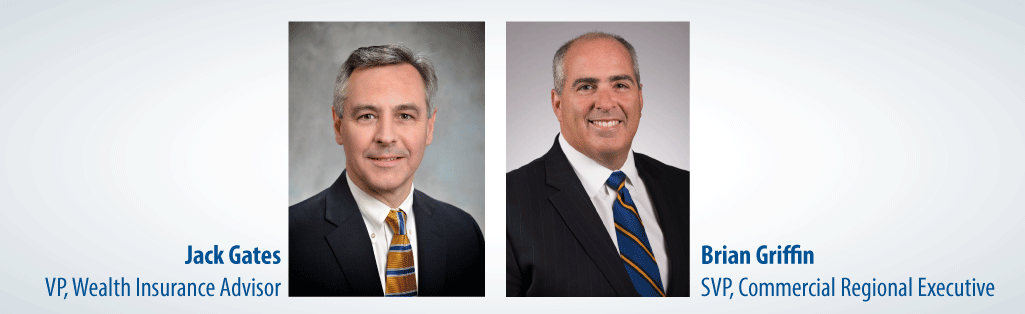
Jack Gates has seen firsthand how an unforeseen ownership change can create challenges for a business. In one case, a majority owner's ownership interest passed to his spouse, leaving the remaining partners with difficult decisions about the future of the company. Without a prearranged buy-sell agreement in place, the partners ultimately relied on substantial bank financing to complete the ownership transition.
“That had an impact on the next five years,” said Gates, an advanced planning advisor for Rockland Trust’s Investment Management Group. “They stayed in business, but it slowed down their progression because they had the added burden of paying off the unexpected bank note.”
That scenario is far from unique. The six Ds — death, departure, disability, disagreement, disqualification and divorce — cause frequent unexpected ownership changes. And demographics suggest that even more retirement transitions are coming. U.S. Census Bureau data for companies with employees shows that 23% have owners who are 65 or older. Another 28% have owners ages 55 to 64.
While retirement is often part of a business owner's long-term plan, unexpected life events can create far greater challenges for both families and business owners and shareholders. That’s why preparing for the six Ds through a buy-sell agreement and appropriate insurance coverage should be part of any business’s continuity plan, Gates said.
For the business partners he worked with, it would have been game changing.
“A life insurance policy on that person would have instantaneously provided the funds necessary to buy out the surviving spouse, and they would have been off and running,” he said.
How buy-sell agreements work
In a buy-sell agreement, a company spells out what happens to an owner’s shares when a triggering event occurs. It details not just who buys the shares but also how the business will be valued. The company then typically arranges to secure life and disability insurance policies on the owners tied to the value of their shares. That way, the benefit funds the purchase.
Few companies have included this agreement in their business plans. In its 2022 Business Owner Perspectives Study, the life insurance company MassMutual found that only 32% of respondents had a buy-sell agreement in place. Of those that did, fewer than half (46%) said it was funded with life insurance. Just 22% said it was funded with disability buyout coverage.
“From a credit perspective, having the insurance in place is really important,” said Brian Griffin, senior vice president, regional commercial banking executive for Rockland Trust. “Rather than relying on company assets or new borrowing to facilitate a buyout, this approach provides liquidity when it's needed most, helping protect the company's balance sheet and financial position.”
Because buy-sell agreements involve several areas of expertise, business owners often rely on a team of trusted advisers to develop and implement a plan. Rockland Trust helps bring those resources together, supporting business owners with the coordination and financial planning needed to prepare for future ownership transitions.
Revisiting the plan regularly also is important. When buy-sell agreements and insurance are in place, they often aren’t updated frequently enough, Gates said.
“If the business has grown, if it’s acquired other companies, and, all of the sudden, it’s four times the size with multiple owners,” Gates recommends reviewing the agreements. Existing buy-sell agreements should be reviewed every five years, or after any significant growth or transition.
Protecting other key people
Ownership transitions aren’t the only personnel transitions businesses need to consider in their continuity preparations. For many companies, unexpectedly losing a key employee can be nearly as challenging as losing an owner. Just like with buy-sell agreements, insurance can help, Gates said.
These policies, known as key man or key person insurance, provide coverage when the loss of an employee could hurt a company financially. If that person dies or, depending on the coverage, becomes disabled, the policy provides money to help absorb lost revenue, keep projects on schedule and hire a replacement. Many U.S. Small Business Administration loans require key person coverage.
“It allows debt to be repaid or allows for some additional liquidity to be put into a company at a time when it probably needs it the most,” Griffin said.
Because a business owner is often a key person in the business, the two types of coverage can go hand in hand.
“If I’m a business owner, I want to ensure there’s adequate life insurance in place so the company has the resources to facilitate a buyout if something happens to me. At the same time, I want key person coverage that helps the business absorb the financial impact of my absence, maintain continuity and provide time to identify the right successor or replacement.”
Planning tools to protect your business
Both types of insurance come as term or cash-value coverage. Opting for a cash-value policy can also create an opportunity to provide a financial benefit for key personnel, Gates said. In that scenario, the company is the policy’s beneficiary, but the employee can receive the policy’s cash value, creating an extra retirement benefit for employees who stay with the company through a vesting schedule.
“It’s tough to find really good people, and maintaining those people is critical,” Gates said. “Making sure you have key person protection for the business and also an executive benefit to tie key employees to the business ensures for a much more well-prepared business.”
The same approach can make a business more valuable when it’s time to sell, because a buyer will want to retain the people who know how the business runs. The cash-value coverage can be structured as a bonus paid to key employees who stay for a set period after a sale.
Most importantly, be prepared for any scenario, Griffin said. Many succession topics are challenging, but the right team of advisers can help owners work through difficult decisions.
For more information about preparing your business for unexpected life events, reach out to Jack Gates.